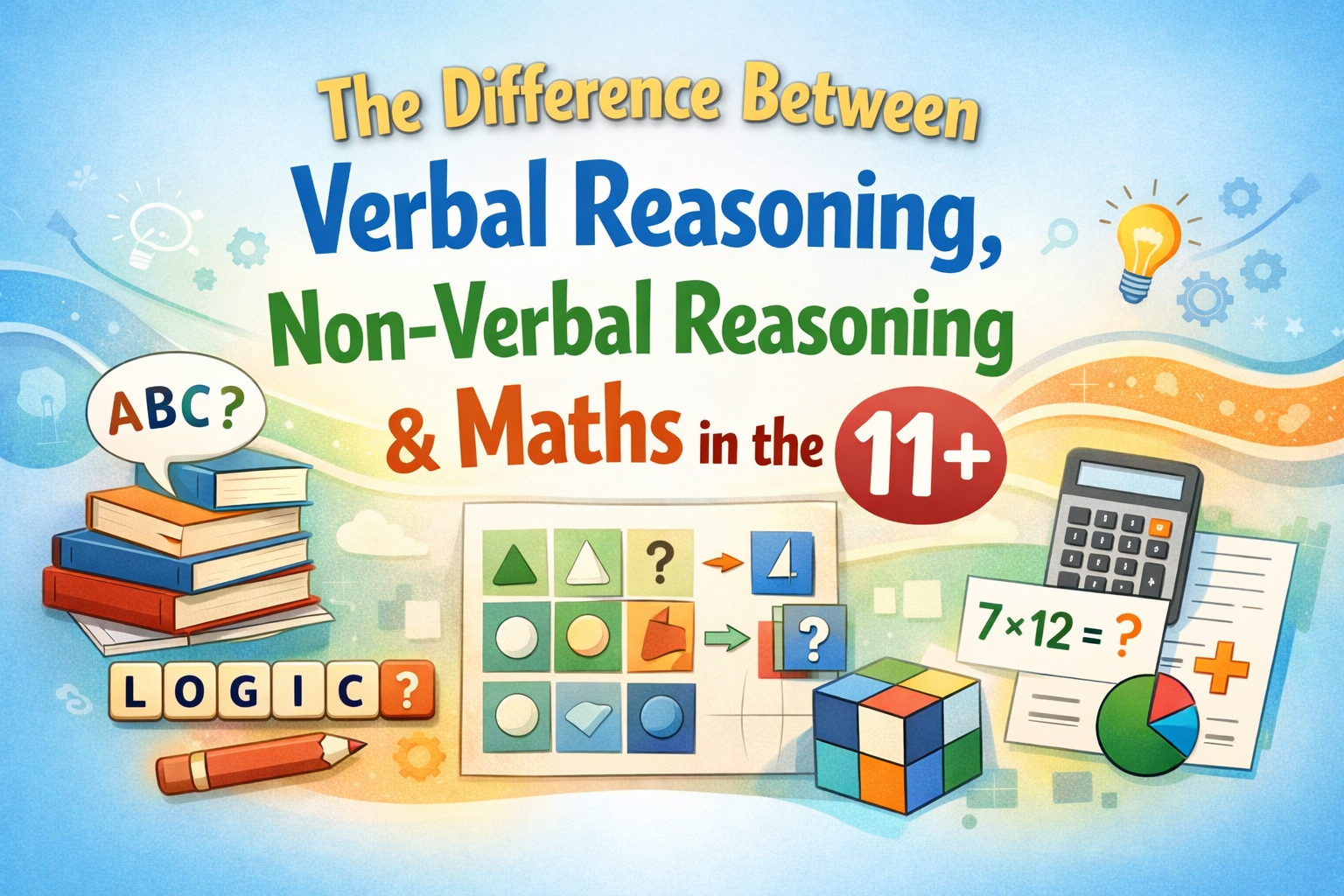
Verbal Reasoning: Thinking with Words
Verbal reasoning tests a child’s ability to understand, analyse and work with language. It looks at how well children can recognise patterns in words, interpret meaning, and apply logic using language.
Rather than simply testing spelling or grammar, verbal reasoning focuses on how children think about words and relationships between words.
Common verbal reasoning question types include:
-
Finding synonyms (words with similar meanings)
-
Finding antonyms (opposites)
-
Completing word analogies
-
Identifying patterns in letter sequences
-
Solving coded word problems
-
Understanding relationships between words
For example, a question might ask:
Book is to library as painting is to…?
The child needs to recognise the relationship between the two ideas rather than simply recall knowledge.
Verbal reasoning therefore depends on:
Children who read widely often develop these skills more naturally over time.
Non-Verbal Reasoning: Thinking with Shapes and Patterns
Non-verbal reasoning removes language from the equation and focuses on visual patterns and spatial thinking.
Instead of words, children work with shapes, diagrams, rotations and sequences. The aim is to see how well they can recognise patterns and relationships visually.
Typical non-verbal reasoning questions might include:
-
Identifying the next shape in a sequence
-
Finding the missing piece in a pattern
-
Spotting similarities between diagrams
-
Rotating shapes mentally
-
Recognising mirror images
For example, a child might be shown a sequence of shapes where one feature changes each time, and they must determine which shape comes next.
Non-verbal reasoning relies heavily on:
Unlike verbal reasoning, it does not depend on vocabulary or reading ability.
Maths: Numerical Reasoning and Problem Solving
Maths in the 11+ usually focuses on core number skills and problem solving rather than complex or advanced mathematics.
Typical topics include:
While strong arithmetic skills are important, maths questions in selective tests often require children to apply their knowledge in unfamiliar situations.
A maths question might involve several steps or require children to interpret information carefully before calculating an answer.
For this reason, success in maths is not just about calculation. It also involves:
How the Skills Work Together
Although these three areas look different, they all assess a similar underlying ability: reasoning.
The 11+ is not simply testing what children have memorised. Instead, it is looking at how they:
Some children find verbal reasoning easier because they enjoy reading and language. Others find non-verbal reasoning more intuitive because they think visually.
Most children improve when they develop confidence with the question types and strategies involved.
Supporting Your Child
Parents sometimes worry that they need to teach large amounts of new content. In practice, preparation is usually more about developing familiarity and confidence.
Helpful ways to support children include:
-
encouraging regular reading
-
practising mental maths
-
introducing reasoning puzzles and pattern problems
-
building vocabulary through conversation and books
-
allowing children to talk through their thinking
The goal is not to create pressure but to help children become comfortable with thinking through unfamiliar problems.
Final Thoughts
The 11+ assesses several different ways of thinking, not just traditional school subjects. Verbal reasoning, non-verbal reasoning and maths each examine different aspects of a child’s ability to recognise patterns, reason logically and solve problems.
When children gradually develop these skills, the exam becomes far less mysterious and far more manageable.
With the right preparation and a calm approach, many children find that reasoning questions can even become enjoyable challenges rather than intimidating tests.