

The 11+ is Changing: What Parents Need to Know About the FSCE
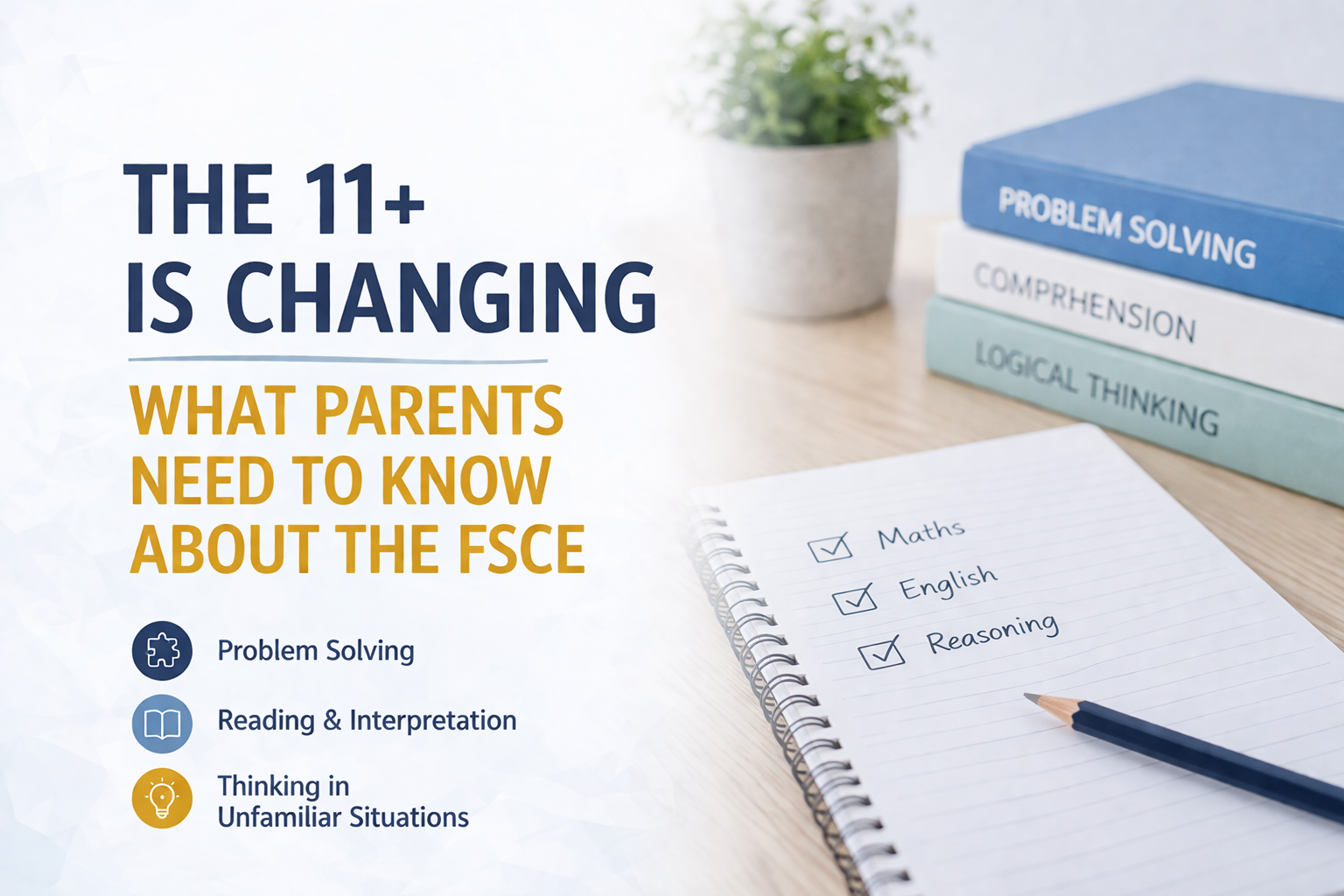
In recent years, some grammar schools have begun moving away from traditional 11+ tests provided by GL Assessment, towards a newer style of assessment developed by Future Stories Community Enterprise.
For many parents, this raises an important question: What actually is the FSCE — and what does it mean for my child?
A shift in what the 11+ assesses
Traditionally, the 11+ has been quite predictable.
Papers have often included:
- Verbal Reasoning
- Non-Verbal Reasoning
- Maths
- English
Over time, familiar question types have emerged — and preparation has often focused on practising these repeatedly.
The FSCE represents a shift away from this model.
Rather than focusing on how well a child has learned specific question types, it aims to assess how well they can:
- think logically
- interpret information
- solve unfamiliar problems
What does the FSCE focus on?
While the exact format can vary slightly between schools, the FSCE generally places greater emphasis on three core areas:
1. Mathematical thinking
This goes beyond straightforward arithmetic.
Children may be asked to:
- solve multi-step problems
- apply knowledge in unfamiliar contexts
- explain or justify their thinking
A secure understanding of Key Stage 2 maths is essential.
2. Reading and interpretation
The English component is less about writing and more about understanding.
This includes:
- reading comprehension
- inference and interpretation
- understanding vocabulary in context
Children need to engage with texts thoughtfully, rather than simply retrieving information.
3. Reasoning across contexts
Reasoning is still important, but it is often less formulaic than in traditional non-verbal reasoning papers.
Children may need to:
- recognise patterns
- make logical deductions
- think flexibly under time pressure
Does the FSCE include creative writing?
This is one area where there is some confusion. For some FSCE 11+ exams, there is a creative writing element. In other FSCE assessments, there is not. Gloucestershire grammar schools have not officially confirmed what the format of the assessment will be. Until they do, it remains speculation if there will be creative writing in it. However, if they follow the other national grammar schools which have adopted the FSCE assessment in recent years, then it is possible that there will be creative writing included in it.
How many papers will there be in the 11+?
Again, this is yet to be confirmed. However, from what other grammar schools have done using the FSCE assessment, it seems possible that there will be four papers, with the first one being a multiple choice English and maths paper (not too dissimiliar from current GL assessments, at least in their assessment style), one English and maths paper that asks students to give short answers to the questions (which is a significant change from the current assessment format), one paper that is creative writing and one paper that is based on wider curriculum knowledge. There could therefore be 4 papers in total, and a significant move away from the traditional GL model of maths, English, Verbal and Non Verbal reasoning.
However, until this is formally confirmed, it can not be taken as certain. What is more clear is when the 11+ will be.
When will the 11+ take place?
Under the current GL assessment, the 11+ takes place at the start of Y6. Under the new FSCE assessment, it will now take place at the end of Y5. This will have benefits for many students – it will help students take the 11+ when they are still in ‘school mode’ rather than at the end of a long summer holiday. This is likely to help all students, especially those who may not have support at home during the holidays to do lots of 11+ practice. It will however also have implications for all students in terms of how long they have to prepare, since they will be taking the 11+ sooner than previously expected. This will necessitate families rethinking their preparation time lines.
Who will this affect?
It will not affect current Y5s, who will complete the GL assessment at the start of Y6. It will affect current Y4s who start Y5 in the 2026-27 academic year. These will be the first students to take the new 11+ assessment in the summer term of Y5. Current Y4s will therefore be taking the 11+ in just over one academic year’s time.
What does this mean for preparation?
This shift changes how children are best prepared for the 11+.
Rather than focusing heavily on repeating question types, effective preparation now tends to prioritise:
- Strong foundations in maths
- Regular reading and discussion
- Exposure to problem-solving tasks
- Developing independence and resilience
In many ways, this aligns more closely with good classroom learning.
A more balanced (but still selective) process
The move towards the FSCE is intended to make the 11+:
- less dependent on intensive tutoring
- more reflective of a child’s underlying ability
However, it is important to be realistic.
Grammar school entry remains highly selective, and children still need to be working at a strong level for their age.
A final thought for parents
For many families, the 11+ can feel uncertain — especially during periods of change.
But the core message is actually quite reassuring: strong reading, secure maths, and confident thinking matter more than ever.
These are valuable skills regardless of the outcome of the test itself.
If you’re a Year 4 or Year 5 parent and trying to decide whether the 11+ is the right path, it can be helpful to talk things through.
Every child’s situation is different — and the best decisions are usually made with a clear understanding of both the process and the child in front of you.
Cheltenham Tutors provides small group and individual tuition for primary school pupils in Cheltenham. Sessions focus on building confidence, strong academic foundations, and thoughtful preparation for selective tests.