
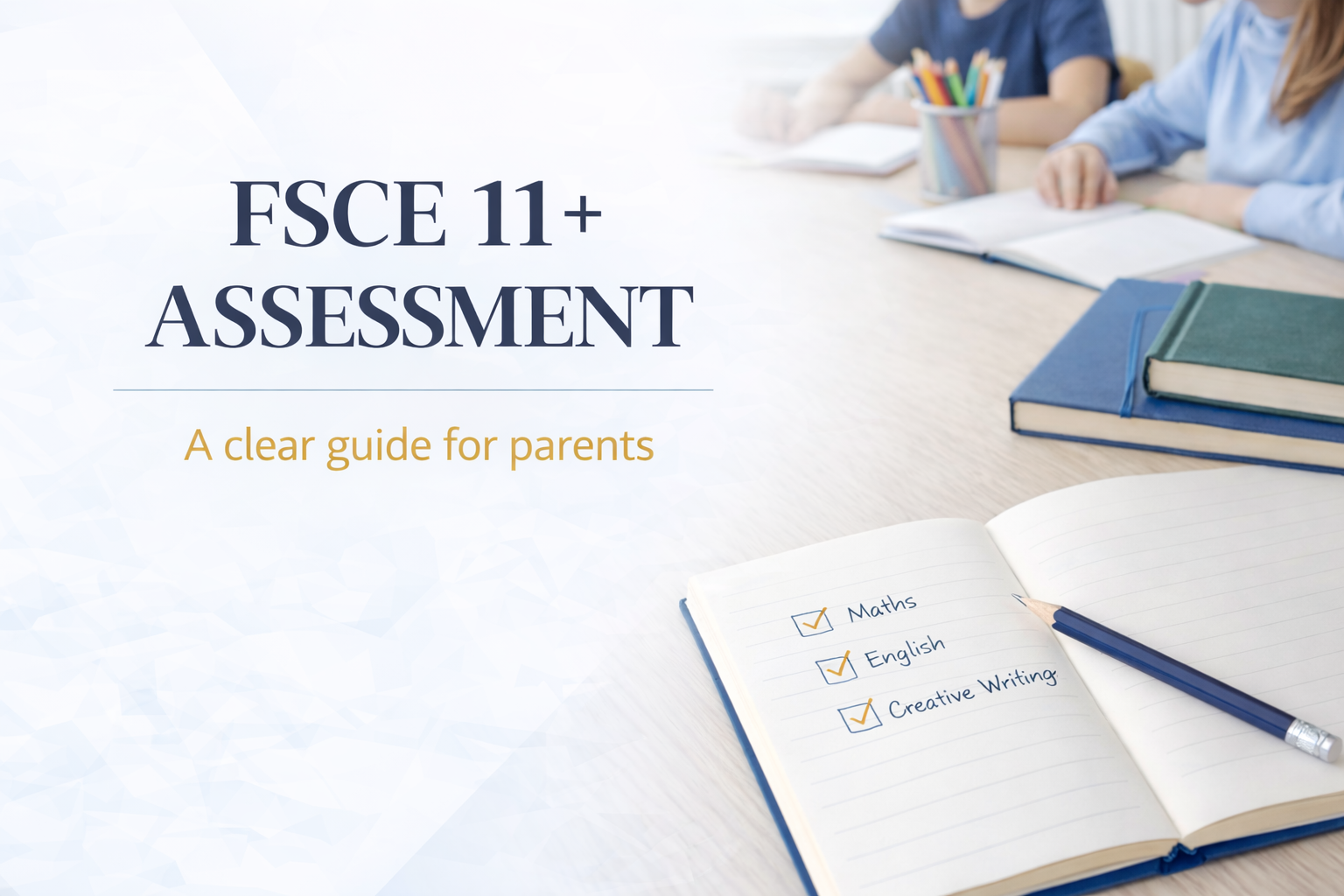
As the 11+ begins to change in some areas of the country, many parents are hearing about the FSCE (Future Stories Community Enterprise) assessment and wondering what it may mean for their child.
This page offers a clear, balanced overview of the FSCE 11+, including:
At present, this information reflects what appears most likely for Gloucestershire based on the official FSCE familiarisation materials and the structure currently used in other areas already working with the FSCE. However, until Gloucestershire grammar schools confirm the final assessment model, some aspects may still change.
You can also:
Parents can watch the full webinar recording here:
The webinar explores:
We have also produced a free downloadable guide summarising the current information available about the FSCE assessment.
This guide is based on the official FSCE familiarisation materials and our own analysis of the assessment direction.
The official FSCE familiarisation materials emphasise that the assessment is designed to reward curiosity, flexible thinking, resilience and broad engagement with learning, rather than narrow exam preparation. You can access two of these guides below:
FSCE: Familiarisation Guide for Children
FSCE: Familiarisation Guide for Parents
The FSCE is a newer grammar school entrance assessment now used by a growing number of selective schools across England.
Unlike older 11+ models, the FSCE appears designed to assess how children apply knowledge and think through unfamiliar situations, rather than how many question types they have memorised.
According to the official familiarisation materials, the assessment is intended to be:
The FSCE materials also state that there are:
The FSCE assessment is expected to be introduced for Gloucestershire grammar school entry from academic year 2026–27.
This means that children currently in Year 4 (during the 2025–26 academic year) are likely to be the first cohort to sit the new assessment.
Another significant change is that the test is expected to move from the start of Year 6 to the end of Year 5.
For many children, this may actually feel more natural, as they will still be fully immersed in school routines and learning habits. However, it does mean that preparation timelines may feel slightly shorter, particularly over the summer period before Year 6.
The current familiarisation materials refer to four papers, although the exact structure may vary between schools and from year to year.
This is a multiple-choice paper covering a range of curriculum areas and reasoning tasks.
Questions may involve subjects such as:
The focus appears to be on careful reading, interpretation and application of knowledge rather than recall of isolated facts.
This is another multiple-choice paper, again drawing from a broad range of curriculum subjects and problem-solving tasks.
The official materials suggest that the FSCE is intentionally designed to vary from year to year, making the assessment less predictable than traditional 11+ formats.
This paper involves short written answers.
Children may need to:
This is likely to place greater emphasis on written accuracy, mathematical fluency and careful thinking.
The Discovery Paper involves a longer creative written response.
Children may respond to:
The official materials describe creativity as “the ability to think of new and imaginative ideas, or to solve problems in original and unique ways.”
However, although the broader FSCE model includes a creativity component, it has not yet been fully confirmed whether Gloucestershire grammar schools will include this exact format. There is some indication that there may not be a creative writing task. At this stage, when we still do not know the full details, it is probably safest to presume that there is unlikely to be a creative writing task, whilst also remembering that the FSCE as an assessment is meant to be creative and flexible in content. Therefore, the lack of creative writing should not make one think that this will be a standard assessment that can be prepared for with extensive practice. It is more likely to be a flexible assessment with variable content that rewards students who think creatively, even if they are not asked to write a creative writing piece.
At present, the familiarisation materials do not refer to traditional GL-style Verbal Reasoning (VR) or Non-Verbal Reasoning (NVR) papers.
Instead, the assessment appears more focused on:
Some reasoning skills may still be assessed indirectly through curriculum-based questions and unfamiliar tasks, but the structure appears quite different from older GL models.
Many parents in Cheltenham and Gloucestershire are familiar with the previous GL-style 11+ assessments.
The FSCE appears to differ in several important ways:
| Traditional GL 11+ | FSCE |
|---|---|
| Heavy emphasis on VR/NVR | Broader curriculum focus |
| Repetitive question types | More varied and less predictable |
| Primarily multiple choice | Mix of multiple choice and written answers |
| Strong focus on test technique | Greater emphasis on application and reasoning |
| Narrower subject range | Wider curriculum coverage |
| Limited creative elements | Possible creativity component |
Overall, the FSCE seems designed to reward:
For families considering 11+ preparation in Cheltenham, the shift towards FSCE changes the emphasis slightly.
Preparation is likely to focus more heavily on:
The official FSCE guidance strongly discourages excessive tutoring and high-pressure preparation. Instead, it repeatedly encourages:
At Cheltenham Tutors, we broadly agree with this direction.
Children are likely to benefit most from becoming thoughtful, adaptable learners rather than simply memorising question types.
Not necessarily — but it is different.
Many parents may find that:
For some children, this may actually feel more natural and less pressured than traditional 11+ models.
At Cheltenham Tutors, our approach aligns closely with the kinds of skills the FSCE appears designed to assess.
We focus on:
If you are considering 11+ tuition in Cheltenham, you are welcome to explore further:
Or:
Register Interest for September Groups
While the format of the 11+ may be evolving, the foundations of strong preparation remain remarkably consistent.
Children who:
are likely to be well placed — whatever form the assessment ultimately takes.