

Y5 maths – What changes from Y4?
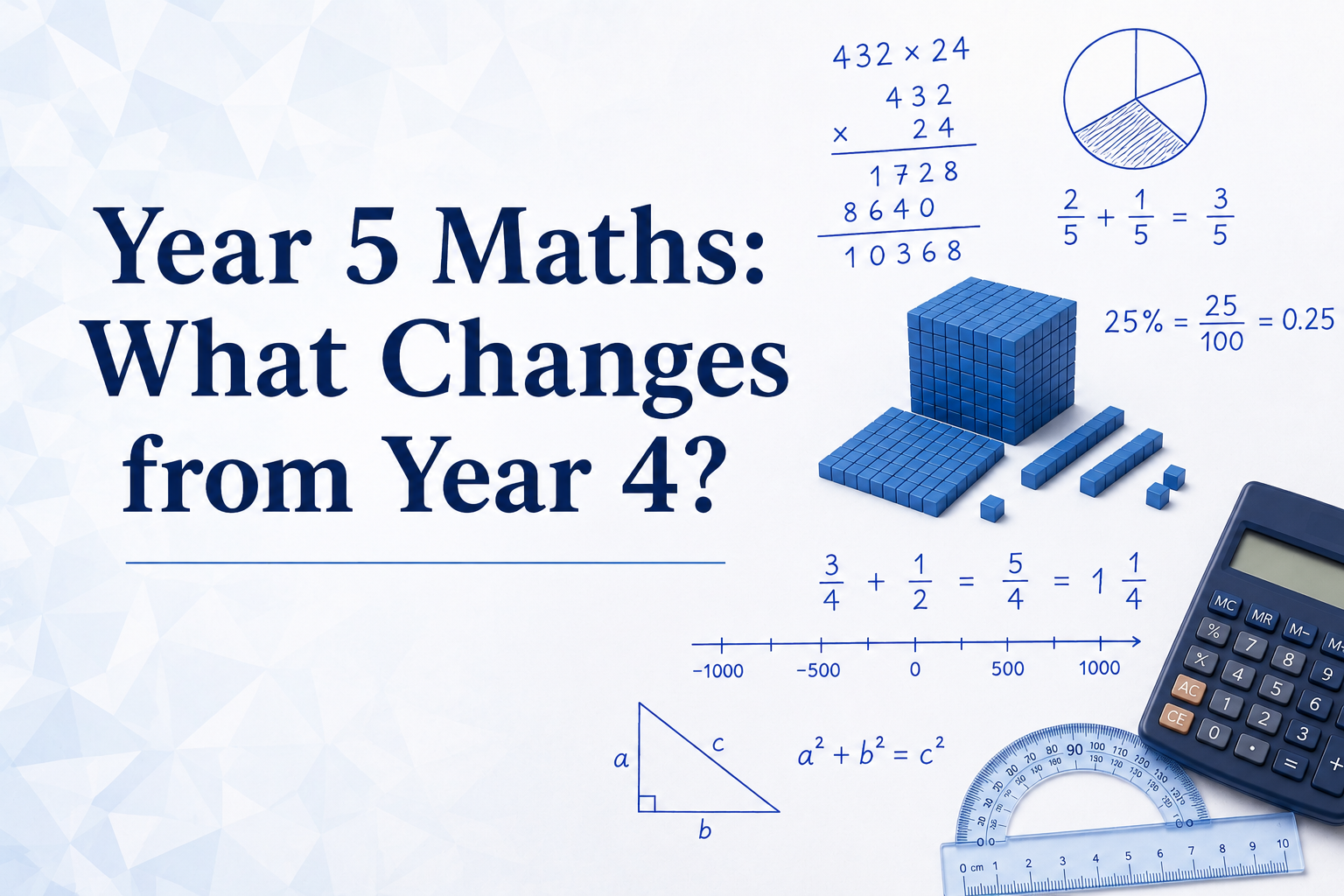
Moving from Year 4 into Year 5 is a significant step in maths. Children are expected to become more independent, more fluent with formal methods, and more confident applying maths to increasingly complex problems.
At Cheltenham Tutors, we often find that children entering Year 5 are capable mathematicians but can feel unsettled by the increased pace and complexity of the curriculum. Understanding what changes — and why — can help parents support children more effectively at home.
In this guide, we explore some of the key differences between Year 4 and Year 5 maths, along with practical ways to build confidence.
1. Place Value Becomes Much Larger
In Year 4, children work with numbers up to 10,000.
In Year 5, this increases dramatically to numbers up to 1,000,000.
Children are expected to:
- Read and write large numbers
- Compare and order them
- Round numbers to the nearest 10, 100, 1,000, 10,000 and beyond
- Understand negative numbers
- Interpret number lines with larger intervals
This shift can feel abstract for some children because the numbers become harder to visualise.
How parents can help
- Discuss large numbers in real life (population, distances, money)
- Practise reading numbers aloud
- Use estimation regularly (“Roughly how many?”)
2. Formal Written Methods Become Essential
Year 4 introduces formal methods.
Year 5 expects children to use them accurately and efficiently.
This includes:
Addition and subtraction
Children move towards:
- Larger numbers
- Multiple exchanges
- Multi-step problems
Multiplication
Children begin multiplying:
- 2-digit × 2-digit numbers
- Larger numbers using long multiplication methods
Division
Children move from simple sharing methods towards:
- Short division (“bus stop” method)
- Division with remainders
- Interpreting remainders in context
A major challenge in Year 5 is that children often understand the method in isolation but struggle to apply it independently in word problems.
Common issue
A child may successfully complete:
432 × 24
…but struggle when asked:
A concert hall has 24 rows with 432 seats in each row. How many seats are there altogether?
This is because Year 5 increasingly tests mathematical reasoning, not just calculation.
3. Fractions Become Much More Advanced
Fractions are one of the biggest jumps between Year 4 and Year 5.
In Year 4, children mainly:
- Recognise fractions
- Compare simple fractions
- Count in fractions
In Year 5, they begin:
- Adding and subtracting fractions
- Converting improper fractions and mixed numbers
- Multiplying fractions by whole numbers
- Finding fractions of quantities
- Comparing fractions with different denominators
For many children, fractions become the point where maths starts to feel less concrete.
Helpful strategy
Use visual models whenever possible:
- Pizza slices
- Bar models
- Fraction walls
- Folding paper
Children who rely purely on memorising rules often become less secure later on.
4. Decimals and Percentages Are Introduced More Deeply
Year 5 links fractions, decimals, and percentages much more closely.
Children learn to:
- Read and write decimal numbers
- Round decimals
- Compare decimals
- Understand percentages as “parts per hundred”
This lays important groundwork for secondary maths and the 11+.
For example:
25%=25100=0.2525\% = \frac{25}{100} = 0.25
Understanding the relationship between these forms is more important than memorising procedures.
5. Problem Solving Becomes More Important
One of the most noticeable changes in Year 5 is the increased emphasis on reasoning.
Children are expected to:
- Explain methods
- Justify answers
- Spot patterns
- Solve multi-step problems
- Choose efficient strategies independently
This is often where previously “strong” mathematicians can wobble slightly.
A child who is quick with calculations may still struggle if they:
- Rush
- Misread questions
- Cannot identify the operation needed
- Lack resilience when problems become unfamiliar
At Cheltenham Tutors, we often encourage:
- Slowing down
- Underlining key information
- Explaining reasoning aloud
- Estimating before calculating
These habits build mathematical confidence as much as mathematical skill.
6. Times Tables Still Matter — A Lot
Even though the Year 4 Multiplication Tables Check is completed by the end of Year 4, times tables remain absolutely critical in Year 5.
Children who are not fluent with multiplication facts often struggle with:
- Fractions
- Division
- Long multiplication
- Percentages
- Area and perimeter
Fast recall reduces cognitive load, allowing children to focus on the reasoning element of maths.
Particularly important tables in Year 5
- 6s
- 7s
- 8s
- 9s
- 12s
7. Maths Confidence Matters More Than Ever
Year 5 is often the point where children begin deciding whether they think they are “good at maths”.
Because the curriculum becomes more demanding, some children can lose confidence quickly — especially if they compare themselves to peers.
A calm, encouraging approach is usually far more effective than pressure.
Children benefit most from:
- Short, regular practice
- Positive reinforcement
- Clear explanations
- Opportunities to make mistakes safely
Final Thoughts
The jump from Year 4 to Year 5 maths is not simply about harder calculations. It is about becoming a more independent mathematical thinker.
Children are expected to:
- Apply methods flexibly
- Solve unfamiliar problems
- Explain reasoning
- Work with larger and more abstract concepts
With the right support, however, Year 5 can become an incredibly important year for developing mathematical confidence before the move into Year 6 and secondary preparation.
If you would like support with Year 5 maths, 11+ preparation, or building confidence in maths and English, visit Cheltenham Tutors to learn more about our small groups and 1-to-1 tuition.
Cheltenham Tutors provides small group and individual tuition for primary school pupils in Cheltenham. Sessions focus on building confidence, strong academic foundations, and thoughtful preparation for selective tests.
Registration is now open for their small 11+ tuition groups. To register, use this form: Register Interest: September 11+ Groups (Cheltenham Tutors) – Google Forms